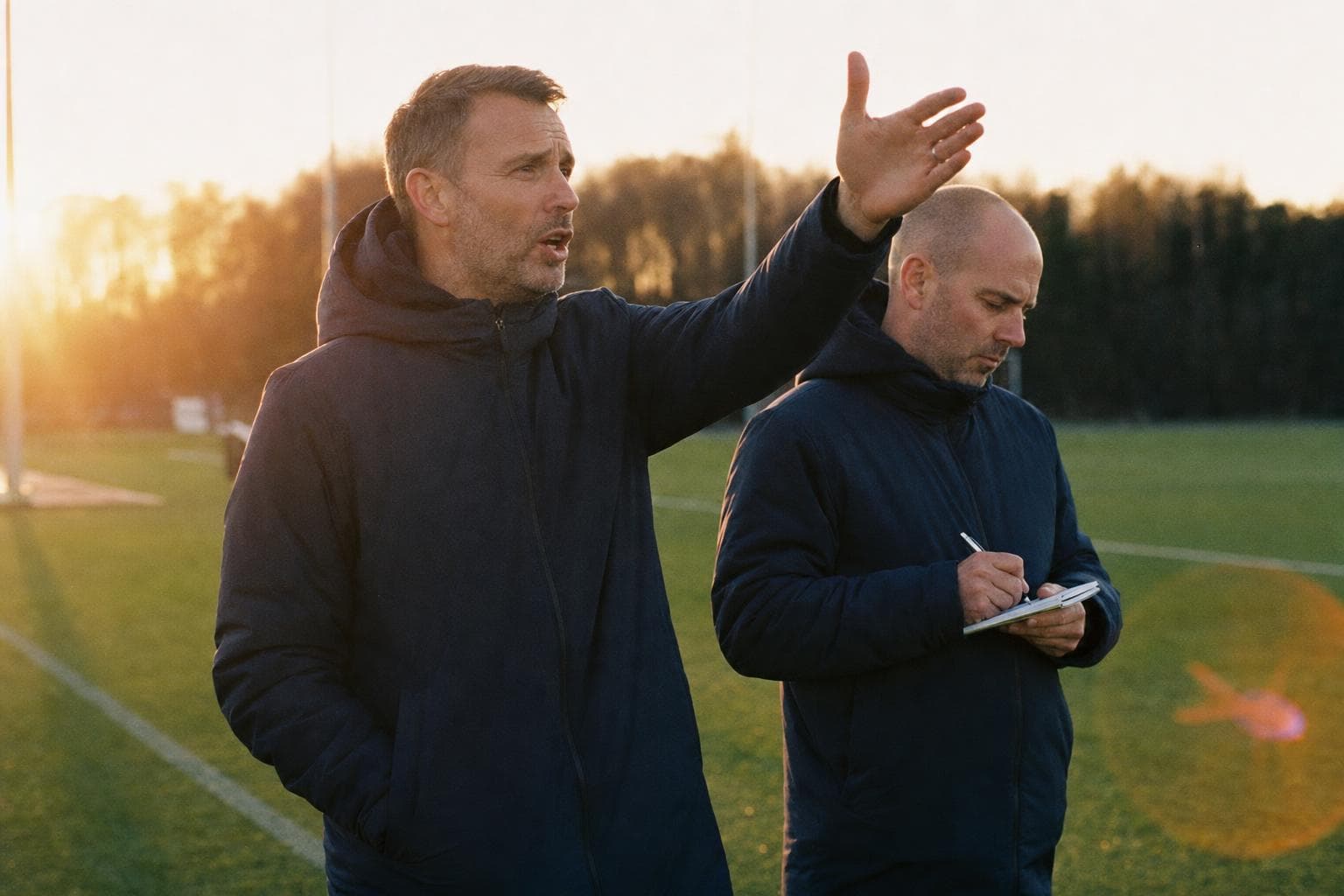
Every head coach knows the feeling. You saw it clearly in the 73rd minute — the fullback stepping out too early, the pocket opening behind him — and you said so, out loud, to whoever was closest. By the time you're back in the office it has evaporated. The analyst never heard it. The set-piece coach heard a different version. The player it concerned heard nothing at all.
The backroom got bigger. The bottleneck didn't move.
A modern professional football staff is ten to thirty people: assistants, analysts, physios, S&C, nutrition, kit, logistics. The head coach's observations are the club's most valuable raw material — and the transport layer for them is still shouting, WhatsApp, and memory.
Research on organisational communication puts the cost plainly: instructions that pass through two or more people lose most of their specificity. Football makes it worse. The coach's day has no gaps in it. The moment to write something down never comes, and the backlog compounds — every unrecorded observation is a decision someone else makes blind later in the week.
What the best staffs already do
The best backroom operations we've studied share three habits:
- They capture at the moment of observation. Not after training. Not in the evening review. The half-life of a tactical observation is minutes, not hours.
- They route by name. "Kenji, cut the build-up clips" is an assignment, not a note. The observation and its owner travel together.
- They close loops explicitly. Work that isn't acknowledged doesn't exist. A staff that confirms receipt outperforms a staff that assumes it.
None of this requires software. It requires discipline that most matchweeks destroy by Tuesday.
The voice-first premise
This is the premise CoCoach is built on: the head coach already produces everything the club needs — out loud, all day. The missing piece is not another dashboard to type into. It is a system that listens when the coach speaks, understands who "Kenji" is, turns the sentence into a task, delivers it in the language the recipient actually thinks in, and reports back when it's done.
The instruction should never depend on who was standing nearby.